

- Education
- Forex Technical Analysis
- Chart Patterns
- Continuation Patterns
- Symmetric Triangle
Symmetrical Triangle: Forex Chart Pattern
DEFINITION:
The Symmetric triangle is considered a trend continuation pattern and may be formed in both uptrends and downtrends. The direction of the trend preceding the pattern’s appearance is confirmed in case of its occurrence on the chart.
Key Moments
- The symmetrical triangle forms when price produces both lower highs and higher lows, creating two converging trendlines that meet at an apex.
- Unlike ascending or descending triangles, the symmetrical version carries no inherent directional bias — the breakout can occur in either direction.
- Volume typically diminishes steadily throughout the formation, reflecting genuine market indecision between buyers and sellers equally matched in strength.
- The breakout — a decisive candle close outside either trendline — signals that one side has finally gained the upper hand and a trend is resuming.
- The profit target is calculated by measuring the triangle's maximum height and projecting that full distance from the exact breakout point.
- False breakouts are common with this pattern, making volume confirmation and a candle close beyond the trendline essential before entering any position.
What is a Symmetrical Triangle Pattern
A symmetrical triangle is a chart pattern formed by two converging trendlines — a descending upper resistance line and an ascending lower support line — meeting at a shared apex. Each swing high within the pattern is lower than the previous one, while each swing low is higher than the one before it, creating the characteristic narrowing shape. This compression reflects a genuine balance of power between buyers and sellers, with neither side able to establish meaningful control.
The pattern belongs to the continuation family, meaning it most commonly appears mid-trend as the market pauses to consolidate before resuming in the original direction. A symmetrical triangle forming within an uptrend therefore has a statistically higher probability of breaking upward, while one appearing within a downtrend is more likely to resolve lower. That said, the pattern offers no directional guarantee on its own, which is precisely why traders wait for a confirmed breakout before committing capital to any position.
Symmetrical triangles appear across all major markets and timeframes — from the five-minute forex chart to the monthly stock chart — making the pattern broadly applicable to different trading styles. On higher timeframes such as the daily or weekly chart, the pattern carries greater analytical weight because more significant market participants have interacted with those price levels over a longer period. Recognising the symmetrical triangle early and monitoring it through to completion gives traders a structured framework for anticipating high-probability breakout opportunities before they fully develop.
How to Trade Symmetrical Triangle Pattern?
Trading a symmetrical triangle requires patience above all else — the pattern is defined by indecision, and entering before the market resolves that indecision is the most common and costly mistake traders make. The process below follows a logical sequence from identification through to active trade management, giving each step its proper weight.
1. Identify the Pattern
Draw a descending trendline connecting at least two lower swing highs and an ascending trendline connecting at least two higher swing lows. Both lines should converge clearly toward an apex, and the overall shape should be visually symmetrical — neither side significantly steeper than the other.
2. Confirm Volume Behaviour
Check that volume has been declining as the pattern develops, confirming that market participation is genuinely contracting during the consolidation phase. Steady volume contraction throughout the triangle adds confidence that the eventual breakout will represent a real shift in momentum rather than random noise.
3. Wait for a Confirmed Breakout
Do not anticipate the direction — wait for a candle to close convincingly outside one of the two trendlines before acting. The breakout is most reliable when it occurs before price reaches the final 25% of the triangle, as very late breakouts near the apex tend to lack the energy needed to sustain a meaningful move.
4. Enter the Trade
Enter in the breakout direction immediately after the confirming candle closes, or wait for a pullback retest of the broken trendline for a lower-risk entry with a tighter stop. The retest approach sacrifices some early movement in exchange for a more favourable entry price and improved risk-to-reward ratio.
5. Set Your Stop-Loss
Place the stop-loss just inside the triangle on the opposite side of the breakout — below the broken upper trendline on a bullish breakout, or above the broken lower trendline on a bearish one. This placement ensures the trade is invalidated quickly and cleanly if the breakout reverses, without giving the position unnecessary room to damage the account.
6. Calculate and Set Your Profit Target
Measure the full vertical height of the triangle at its widest point — from the first swing high to the first swing low — and project that distance from the breakout point in the breakout direction. This measured-move target gives the trade a logical, structure-based objective and a clear risk-to-reward ratio to evaluate before the position is opened.
Symmetrical Triangle Formation
The Symmetric triangle is characterized by a narrowing price range between high and low prices, visually forming a triangle. The main distinctive feature of this type of triangles is that it has a descending trendline ( resistance) connecting lower and lower highs and an ascending trendline (support) connecting higher and higher lows. The trendlines’ angles are roughly the same.
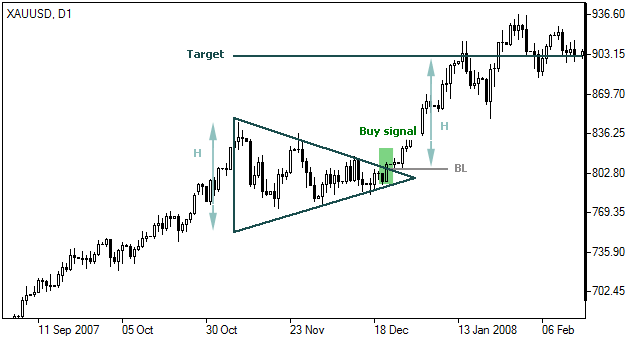

Interpretation of Symmetric Triangle
This pattern confirms the trend movement direction in case of breaking through:
- when the triangle is formed in a downtrend and the price breaks below the support line (plus certain deviation is possible), a sell signal is received;
- alternatively if the triangle is formed in an uptrend and the price breaks above the resistance line (plus certain deviation is possible), a buy signal is received.
Target price
Following a symmetric triangle pattern formation the price is generally believed to fall or rise at least to its target level, calculated as follows:
In case of an uptrend: T = BL + H In case of a downtrend: T = BL – H Where:T – target price;
BL – breakthrough level (point where the price leaves the triangle);
H – pattern’s height (distance between support and resistance lines at pattern’s origin).
Forex Indicators FAQ
What is a Forex Indicator?
Forex technical analysis indicators are regularly used by traders to predict price movements in the Foreign Exchange market and thus increase the likelihood of making money in the Forex market. Forex indicators actually take into account the price and volume of a particular trading instrument for further market forecasting.
What are the Best Technical Indicators?
Technical analysis, which is often included in various trading strategies, cannot be considered separately from technical indicators. Some indicators are rarely used, while others are almost irreplaceable for many traders. We highlighted 5 the most popular technical analysis indicators: Moving average (MA), Exponential moving average (EMA), Stochastic oscillator, Bollinger bands, Moving average convergence divergence (MACD).
How to Use Technical Indicators?
Trading strategies usually require multiple technical analysis indicators to increase forecast accuracy. Lagging technical indicators show past trends, while leading indicators predict upcoming moves. When selecting trading indicators, also consider different types of charting tools, such as volume, momentum, volatility and trend indicators.
Do Indicators Work in Forex?
There are 2 types of indicators: lagging and leading. Lagging indicators base on past movements and market reversals, and are more effective when markets are trending strongly. Leading indicators try to predict the price moves and reversals in the future, they are used commonly in range trading, and since they produce many false signals, they are not suitable for trend trading.

Not sure about your Forex skills level?
Take a Test and We Will Help You With The Rest
You can see the graphical object on the price chart by downloading one of the trading terminals offered by IFC Markets.



Was this article helpful?

 You can study CFD trading more thoroughly and see CFD trading examples in the section How To Trade CFDs Visit Educational Center