

- Education
- Forex Technical Analysis
- Chart Patterns
- Continuation Patterns
- Descending Triangle
Descending Triangle: Forex Chart Pattern
DEFINITION:
The Descending triangle is a trend continuation pattern typically formed in a downtrend that serves for existing direction confirmation.
Key Moments
- The descending triangle forms when price produces a series of lower highs while repeatedly testing the same flat horizontal support level.
- A breakdown below that flat support line — confirmed by a candle close beneath it — is the primary signal to act on.
- Volume typically contracts throughout the formation phase, then expands sharply at the moment of the breakout below support.
- The profit target is measured by taking the pattern's full height and projecting that distance downward from the breakout point.
What is Descending Triangle Pattern
A descending triangle is a bearish chart pattern defined by a flat horizontal support line and a downward-sloping resistance trendline converging above it. Price makes a succession of lower highs as the declining resistance compresses the market toward the unchanged support level sitting below. The pattern visually illustrates a tug-of-war where sellers grow progressively more aggressive while buyers defend the same price floor with diminishing conviction.
Unlike the symmetrical triangle, which reflects balanced indecision between buyers and sellers, the descending triangle has a clear directional tilt toward the downside built into its very geometry. As a continuation pattern, it appears most frequently within established downtrends, confirming that the prevailing selling momentum is pausing rather than reversing. Less commonly, it also forms as a reversal pattern at the end of a sustained uptrend, though this scenario carries somewhat lower statistical reliability.
The descending triangle appears across every major tradeable market — from forex pairs like USD/JPY and GBP/USD to equity indices, commodities, and individual stocks on any timeframe. On higher timeframes such as the daily or weekly chart, the pattern carries greater statistical weight because more market participants have had time to interact with those price levels. Its visual clarity and logical structure make it one of the most widely recognised and studied bearish patterns in all of technical analysis.
How to Trade a Descending Triangle Pattern?
Trading a descending triangle successfully follows a clear, repeatable process — from correctly identifying the pattern to managing an open short position with discipline.
1. Identify the Pattern
Locate at least two progressively lower swing highs and two or more touches of the same flat horizontal support level below them.
2. Confirm Volume Behaviour
During the formation phase, volume should visibly contract, reflecting market compression as price oscillates within the narrowing triangle structure.
3. Wait for a Confirmed Breakout
Never enter short prematurely — wait for a candle to close decisively below the flat support line, ideally accompanied by a noticeable volume spike.
4. Enter the Trade
Place a short entry just below the broken support level, or wait for a pullback retest of that level now acting as new resistance.
5. Set Your Stop-Loss
Position the stop-loss just above the most recent lower high inside the triangle, protecting the trade if the breakout unexpectedly reverses upward.
6. Calculate Your Profit Target
Measure the triangle's full height from support to the highest resistance point, then project that exact distance downward from the breakout level.
7. Manage the Open Position
Monitor momentum and volume as price moves toward the target; consider taking partial profits if price pauses or consolidates at a visible support zone below.
Is a Descending Triangle Bullish or Bearish?
The descending triangle is predominantly a bearish pattern, signalling that selling pressure is building toward an eventual and decisive downside breakout. Its defining structure — lower highs steadily pressing down onto an unchanged support floor — shows mathematically that sellers are gaining strength with each successive price cycle. When support ultimately fails under sustained selling pressure, the resulting decline is frequently sharp, as trapped buyers add momentum by closing their losing long positions below the line.
However, a meaningful minority of descending triangles resolve with an unexpected upward breakout rather than the anticipated move lower. Experienced traders therefore always wait for a confirmed close below support before committing capital to a short position, never entering simply because the pattern is present. An upward false break followed by a reversal can trap early short sellers and trigger a swift, punishing counter-trend rally that damages both positions and confidence.
Context plays a decisive role in assessing the descending triangle's true directional probability before any trade is placed. A pattern forming within a clear, well-established downtrend carries a significantly higher likelihood of a bearish resolution than one appearing after a prolonged upward move. Combining the pattern's internal structure with the broader trend direction, volume behaviour, and prevailing market conditions gives traders the most complete and reliable picture before committing to either a breakout or a counter-trend position.
Descending Triangle Formation
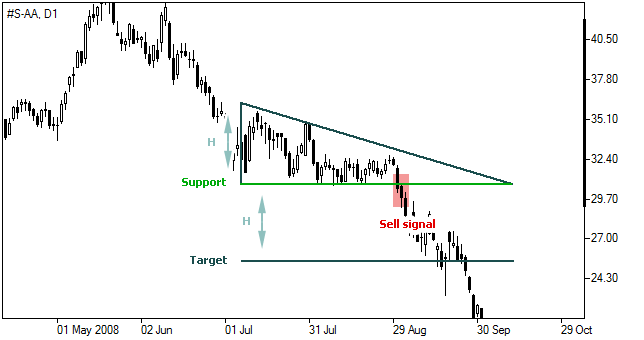
The Descending triangle is represented by a narrowing price range between high and low prices, visually forming a triangle. The main distinctive feature of this type of triangles is that it generally has a descending trendline ( resistance) connecting lower and lower highs and a horizontal trendline (support) connecting the low points at approximattely the same level.

Interpretation of Descending Triangle
When the price breaks below the support line (plus certain deviation is possible), usually somewhere between halfway and three-quarters of the way through the pattern, a sell signal is received.
Target Price
Following a descending triangle pattern formation the price is generally believed to fall at least to its target level, calculated as follows:
T = S – H, Where:T – target price;
S – support (horizontal line);
H – pattern’s height (distance between support and resistance lines at pattern’s origin).

Not sure about your Forex skills level?
Take a Test and We Will Help You With The Rest
You can see the graphical object on the price chart by downloading one of the trading terminals offered by IFC Markets.



Was this article helpful?

 You can study CFD trading more thoroughly and see CFD trading examples in the section How To Trade CFDs Visit Educational Center